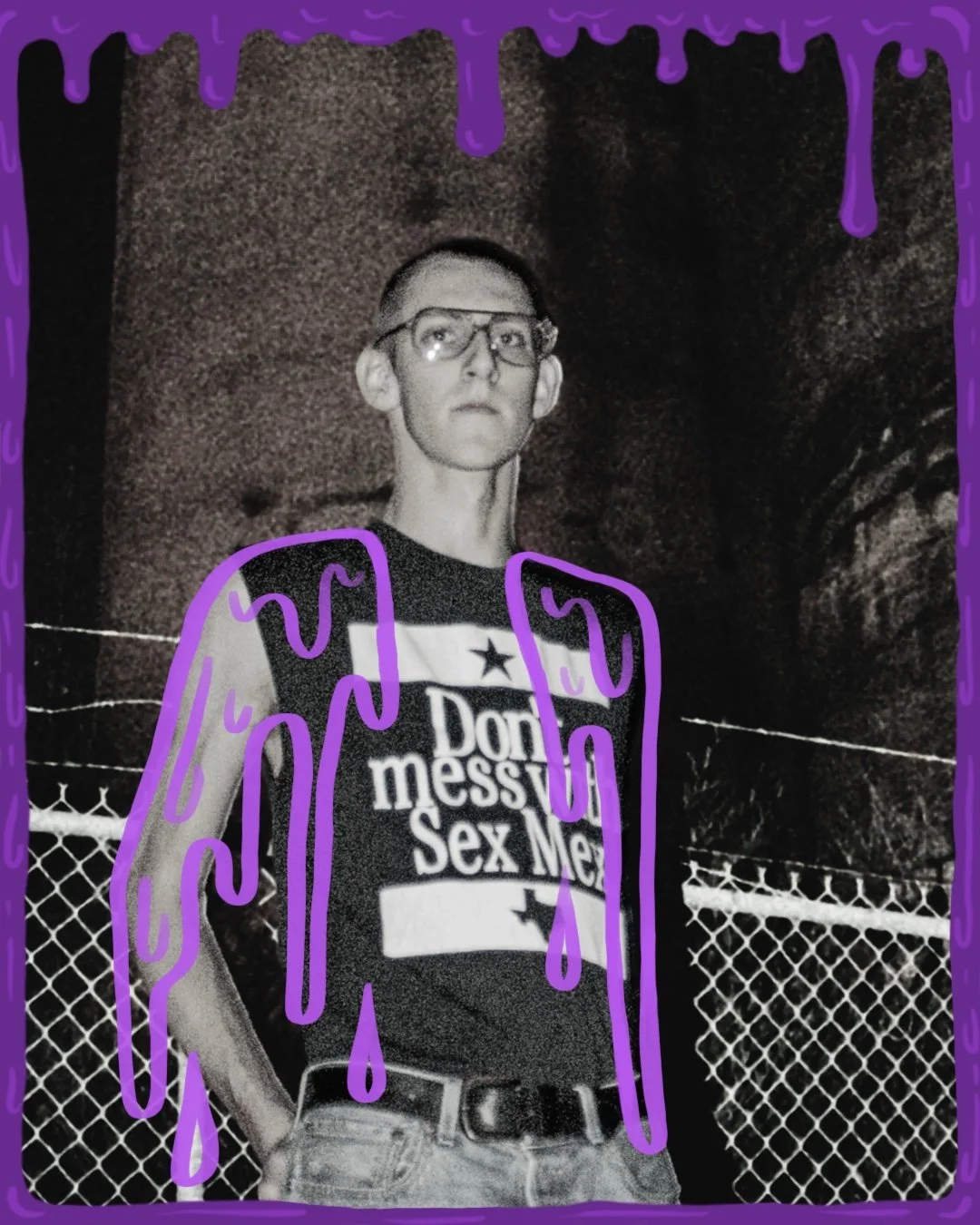
MELT Exclusive: Sex Mex
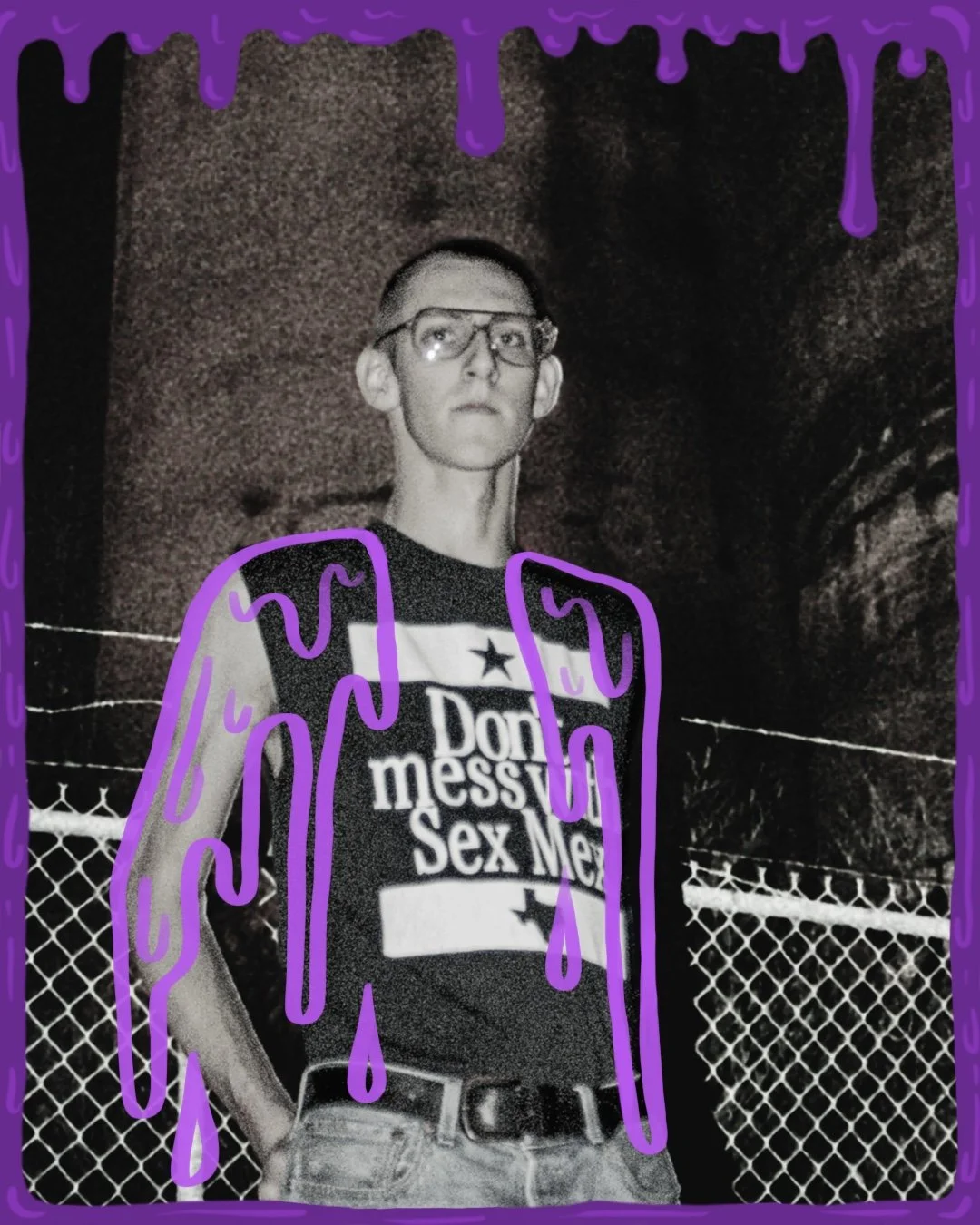
When Sex Mex (Clark Gray) takes the stage, his act is somewhat unassuming. How loud, how encompassing, could one man sitting behind a drum set with amps on either side truly get? But once the retro synth lines start bleeding through the venue, once Clark’s saturated vocals start filling the atmosphere, interspersed with the near-deafening clash of his breakneck rhythms, you start to get it.
At least I did.
Sex Mex, for Gray, is a project taken to its extremes—and not simply in terms of sound. It’s an ever-churning punk endeavor, and each of Clark’s numerous shows and tours are done almost completely DIY. He rents a car, books a couple dozen stops, and heads out on the road with his wife. It’s grueling, but as he puts it, it’s far better than punching a time clock.
The project is one of curiosity, to see how far Gray can take it on his own. That’s the ethos behind his decision to perform solo, and it’s the thread that binds together each piece of his expanding discography.
I spoke with Gray before his show at The Sinkhole in St. Louis alongside local bands Rum Luck and Spent Film, and it’s hard not to walk away with that sort of impression.
This transcript has been lightly edited for the sake of brevity and clarity.
How long have you been on the road for on this go-around?
I think about two weeks now. Let me look at the calendar.
Almost two weeks, tomorrow. Show number 10.
Wow, you've been packing them in. And do you feel that venues like Sinkhole, these smaller DIY venues, are better suited for the act and for the show you put on in general? Is this typically the type of venue you play?
I used to play stuff like this more.
Now it's a little bit more, I'd say 30/70, like I have to do a sound check. So something like this, you know, I just get up on stage and the drums aren't even mic'd and I like that kind of stuff.
I don't know if I'd ever want to get too past the point though, where the stage would be super elevated and far away from the crowd. Or almost like the stage is too big, especially since I'm only one guy. So if I was one guy on a really big stage, it would look kind of weird.
Well, that's actually part of why I was asking is because having that kind of proximity to the crowd, I feel like would be better.
It helps a lot. Yeah.
Tell me about how Sex Mex as a project took on this form. Was it always kind of a one-man thing?
It was always just me recording everything.
It started off as a two-piece, garage rock sort of thing and then evolved into a three piece and then briefly went back to a two piece and a one piece and then became a four piece band and then a three piece band and then two piece kind of band and then this. At some point you start incorporating tracks and it's like, ‘Well, if I already have a track for one thing, what f*cking difference does it make?’ I'm already having to use a metronome.
Is that kind of how that decision played out? Was it just circumstance?
Yeah. It just kind of happened that way. And financially it ended up working out better, which wasn't something I wasn’t really actively thinking about beforehand. I just kind of started doing it out of necessity and then it got going.
This is way better for me. The only reason I'm able to play as many shows as I do is because it's all I do. But the only reason it's all I do is because it's just me. [It wouldn’t work] if I had to split it with four other people. So there's two people involved—me and my wife.
Because we're married, we're basically one person. We just have to eat a little bit more than the average person, but she doesn't even drive. So we only have one, I say car payment, I don't even have a car payment anymore.
I rent vehicles for all the tours because I have a piece of sh*t. So no car payment, no nothing like that. So it's really easy to kind of just do this, you know, I’m not like rolling in the dough, but I'm making a little bit more than I would have if I was working at Amazon or something, which is what I was doing before.
So, you mentioned tracks. I haven't seen you live before, but I imagine that's a big part of your show performing as one person. Was it a challenge at all figuring out how to balance that with the live aspects? Or did it come naturally to you based on your experience recording solo?
I've been doing sound-related stuff since I was like 14. So that definitely helped a lot. But actually doing what I'm doing was just a combination of being around long enough and learning about music that I like, taking different ideas from people. So something like this, it was actually taken from Jay Reatard's Blood Visions because he recorded a lot of the stuff direct.
And I don't even know if it's true. It might've just been direct guitars, but I heard one time that he recorded it direct and then re-amped it. I was like, okay, well, that's the thing that people do in the studio. So screw it, might as well do it live. So that's where that kind of idea came from.
But everything I've ever done has just been bits and pieces of God knows how many people. I just take the stuff that I like from anything I listen to. And then if you take from enough things at some point, people just recognize it as its own thing. Cause it's impossible for people to know everything that you've ever listened to and taken inspiration from.
And then do you ever miss playing in that band setting at all? Because I know that's your background as well.
I don't miss it not being tight. I do miss the sense of ‘Ah, f*ck it.’
It felt more loose and, because of that aspect, it just wasn't as good of a show. I definitely don't miss trying to synchronize stuff with several different people and trying to get everybody on the same page, which is definitely harder to do when it's a collaborative thing. But also when other people get jobs that are way too cushy, it's harder for them to do stuff like this starting out. So they have a baseline level of comfort that they're not willing to go underneath.
I have an advantage in the sense thatI never went to school and I never got to go any further above, you know, bulls*it warehouse stuff. So doing this, this is awesome. For other people it might not be awesome, but to me, it's awesome.
Well, let's pivot to the recording side of the project. When you set out to start Sex Mex, did you have a concrete idea of the, for lack of a better word, niche of punk music and music in general you wanted to aim for?
No [laughs]. I was doing stuff with real drums, and I was using the drum machine to do demos.
And I got done with the demo for the song ‘Pills’. That was the first one I did, and I liked it so much as it was, I was like, ‘I'm just going to put this out instead of re-recording it and all that other stuff.’
At the time it was nothing crazy, but I had all this other stuff out and that song immediately shot up to number one. And I was like, ‘Okay, so it looks like I'm doing this now,’ [laughs]. And it's kind of just been that from there.
I'm not going to go back now. That would, that'd be dumb.
So apart from that one track, as you've moved on in the project, how do you typically approach the songwriting process? It seems to me like a lot of your songs are written from a third-person or from an outside perspective.
Where do you draw the inspiration for those perspectives, or can you just tell me about your process more generally?
This is kind of dorky, but my favorite class in school was English. And I always did pretty well at it. And one of the things that I kind of took away from my essay writing was that it's harder to be persuasive if you tell it from your perspective. Just generally speaking, nobody cares. If you have to make a criticism of something, it's easier almost to put yourself in that person's shoes instead of being like ‘You're dumb. And I think you're dumb and you suck,’ and yada, yada.
You can just make it ‘I'm a f*cking idiot and I do this and I do that. Look at me.’
I feel like a lot of punk music, it's just like [points] ‘You, you, you, you,’ and I'm kind of doing the same thing, you know, like, ‘F*ck you guys, f*ck you guys.’ But I'm not the one saying it.
Say you sit down to write a song. Do you start with a criticism? Do you start with a character or perspective or where does it begin?
No, I start with a hook and then lyrics are the last thing. So I'll have a hook in mind, maybe a title as usually a part of it.
And I'll improvise, either on guitar or piano or keyboard or whatever, the structure. And then later I'll build a chorus off the top of that. Once I get the chorus, I do the verses. And then, usually as I'm writing the verses, it's like, ah, I need to make this song about this. That's where this is going.
You kind of just start writing sh*t. And, uh, sooner or later you figure it out.
So the way I imagine your process is it’s improvised— churn out song, churn out song, because like you said, you're always working. At what point do you sit and collect them into a full-length project?
So I've only done an album properly one time. It was most recently. I'll be honest, I didn't enjoy doing it.
Everything I've done up until this point has been a compilation of singles. I didn't actually enjoy making an album very much. I like going a song at a time. And I think that that has maybe more to do with my age.. Because SoundCloud was a big deal when I was in school, and nobody on SoundCloud was thinking, ‘I'm going to make an album of the year.’
So I think that that's just probably just an age thing. Obviously there's people my age who make albums. I'm not going to say that's not the case, but, me personally, I don't.
I was meaning to ask that more specifically, because Spotify doesn’t differentiate between an album and a collection of songs.
Spotify doesn't care. A song on an album could do insanely well, and there can be another song on the same album that nobody listens to. It's just a glorified playlist.
Spotify operates on an independent track basis.
So I'll pivot the question then, having that context. When do you typically feel it's time to compile those singles?
When there's 12 of them [laughs]. Between 10 and 12.
And how do you feel like the Sex Mex project has changed or evolved over the years you've been doing it, specifically within the recording context?
I use better equipment now. I kind of know what I'm doing better.
Now I get to use actual gear to make things sound like sh*t as opposed to just making it sound like sh*t on the computer.
Feel free to shoot this question down. I'm just curious. Apart from the fact that it obviously is your livelihood, what do you think inspires you and motivates you to keep the Sex Mex project going on a day-to-day basis, keep going out on the road, keep doing these things?
The big reason is because I don't want to work a regular job. As much as this sucks sometimes, because life is life, it's still 10 times better than punching a time clock. That's the main reason.
I guess it’s also partially just a curiosity to play the long game in a sense.
I’ve got booking agents now, but they're independent. I self-release everything, and that's the only reason I get to do what I do. I don't think any label would be happy with how I release music.
I got talked to by a label one time, and they were doing an interview. They were like, ‘So you just took that song down cause you felt like it? Well, we'll come to this show in this city.’
They didn't.
For me, it's mainly just a curiosity thing, being pretty much independent. How far can I get? We'll see.
And then this is more of a fun question. I don't want to say ‘gun to your head’ cause that sounds kind of violent, but take that same sentiment. Before you started the Sex Mex project, say I put you in front of a tribunal and they said, ‘We're going to put you in prison for the rest of your life if you don't start a project under a different genre or with a different set of influences.’ What would you choose?
And then I had to pursue that for the rest of my life?
At least as long as you've done Sex Mex to this point.
Okay. I've actually thought about this a lot. I would probably do something still with tracks, just because it would be half-*ss recording experiment.
But listen to the album We're Only In It For the Money by The Mothers of Invention. How do I put it? Like psychedelic pop music, but not in the Rolling Stones with the sitar way. I don't know.
Something like that as opposed to what I'm doing now.